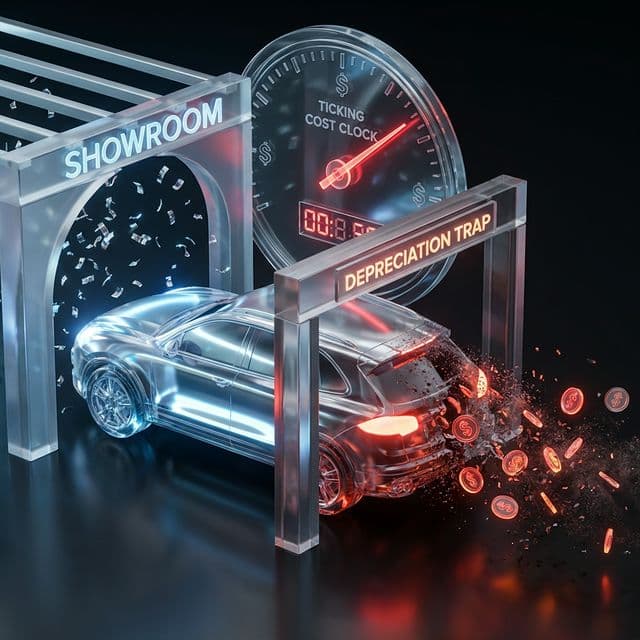
Cars are not bad purchases. They are just easy purchases to mis-measure.
Most buyers compare:
- •showroom price,
- •monthly EMI,
- •and maybe fuel economy.
But the real decision is about total cost of mobility over the years you plan to own the vehicle.
The first number to respect: value loss
IRDAI's motor-insurance guidance talks about IDV in terms of current market value. That is a useful reminder that car value is not static.
In the real resale market, the exact fall in value depends on:
- •model,
- •city,
- •mileage,
- •ownership history,
- •brand perception,
- •and whether the car is kept for three years or ten.
So there is no honest universal rule like "every car loses exactly X% instantly." What is true is simpler: cars are generally depreciating assets, and short ownership cycles make that depreciation much more expensive.
A worked five-year ownership example
Assume you buy a ₹15 lakh car with:
- •₹3 lakh down payment
- •₹12 lakh loan
- •9% interest
- •5-year tenure
That creates an EMI of roughly ₹24,900 a month and total loan interest of about ₹2.9 lakh over the tenure.
Now add some realistic five-year operating costs:
| Cost component | Illustrative amount over 5 years |
|---|---|
| Interest on loan | ₹2.9 lakh |
| Insurance | ₹1.6 lakh |
| Fuel | ₹4.0 lakh |
| Servicing and routine maintenance | ₹0.75 lakh |
| Tyres, battery, minor replacements | ₹0.40 lakh |
| Value lost if resale drops from ₹15 lakh to ₹7.5 lakh | ₹7.5 lakh |
That is an economic cost of roughly ₹17 lakh over five years, before parking surprises, accessories, challans, and larger accident-related events.
This is why a car can feel "affordable" on EMI and still be an expensive overall decision.
The opportunity-cost question most buyers skip
Suppose you could instead buy a reliable used car and save ₹12,900 a month versus the new-car route.
If that difference goes into an investment growing at an illustrative 12% annual return, it can become roughly ₹10.5 lakh over five years.
That does not mean "never buy a new car." It means the size of the upgrade deserves the same seriousness as any other long-term money decision.
When buying new is still reasonable
A new car can be a sensible choice when:
- •you plan to keep it for a long ownership cycle,
- •the EMI and running cost leave your savings rate intact,
- •the vehicle meaningfully improves family reliability or business use,
- •and you are not sacrificing emergency reserves or retirement investing to stretch into it.
The strongest cases for buying new are usually based on fit, safety, and long holding period, not on emotion disguised as financial logic.
When the math deserves extra caution
Be more careful when:
- •you upgrade every three to five years,
- •the total monthly car cost crowds out investments,
- •you are using a long tenure mainly to make the EMI look comfortable,
- •or the new car is being justified as a "reward" despite a thin cash buffer.
New versus used is not a religion
Used cars are often financially superior because someone else absorbs the early depreciation. But they are not automatically better in every case.
A used car can be a weak decision if:
- •service history is poor,
- •safety standards are meaningfully lower,
- •you buy a false bargain that turns into repair spending,
- •or financing terms are unattractive.
The point is not "always buy used." The point is "price the full decision."
A better buying checklist
Before signing the loan:
- •Estimate five-year cost, not just EMI.
- •Decide how long you realistically keep cars.
- •Check whether the purchase slows down emergency-fund and SIP goals.
- •Compare the new-car route with one smaller or used-car alternative.
The practical takeaway
The purchase price gets the attention, but depreciation, financing, and running costs create the real bill.
If you still want the car after seeing the full five-year math, buy it with open eyes. That is a much better position than buying a car because the EMI looked manageable in a showroom chair.
Frequently Asked Questions
Is it better to buy a new car or a used car?+
How much of my salary should go towards a car EMI?+
Should I take a personal loan or a car loan?+
Sources & References
Disclosure & Update History
This content is for educational purposes only and is not personalized financial, tax, or legal advice.
Update history
- Originally published on 21 February 2026.
- Latest editorial review completed on 18 March 2026.
- Sources cited on this page are reviewed during each editorial refresh.
Tags
Written by Amodh Shetty
Amodh is a personal finance educator and the founder of KnowYourFinance. He focuses on Indian taxation, investing, insurance, and household decision-making frameworks.
Editorial disclosure: The author holds investments in broad-market index funds and SGBs. This article is strictly for educational purposes and does not constitute professional investment advice.
Need Calculators Alongside the Guide?
The article stands on its own. If you want an iPhone companion for running scenarios, saving inputs, and using India-focused calculators, you can use the KnowYourFinance app.
Explore the iPhone App