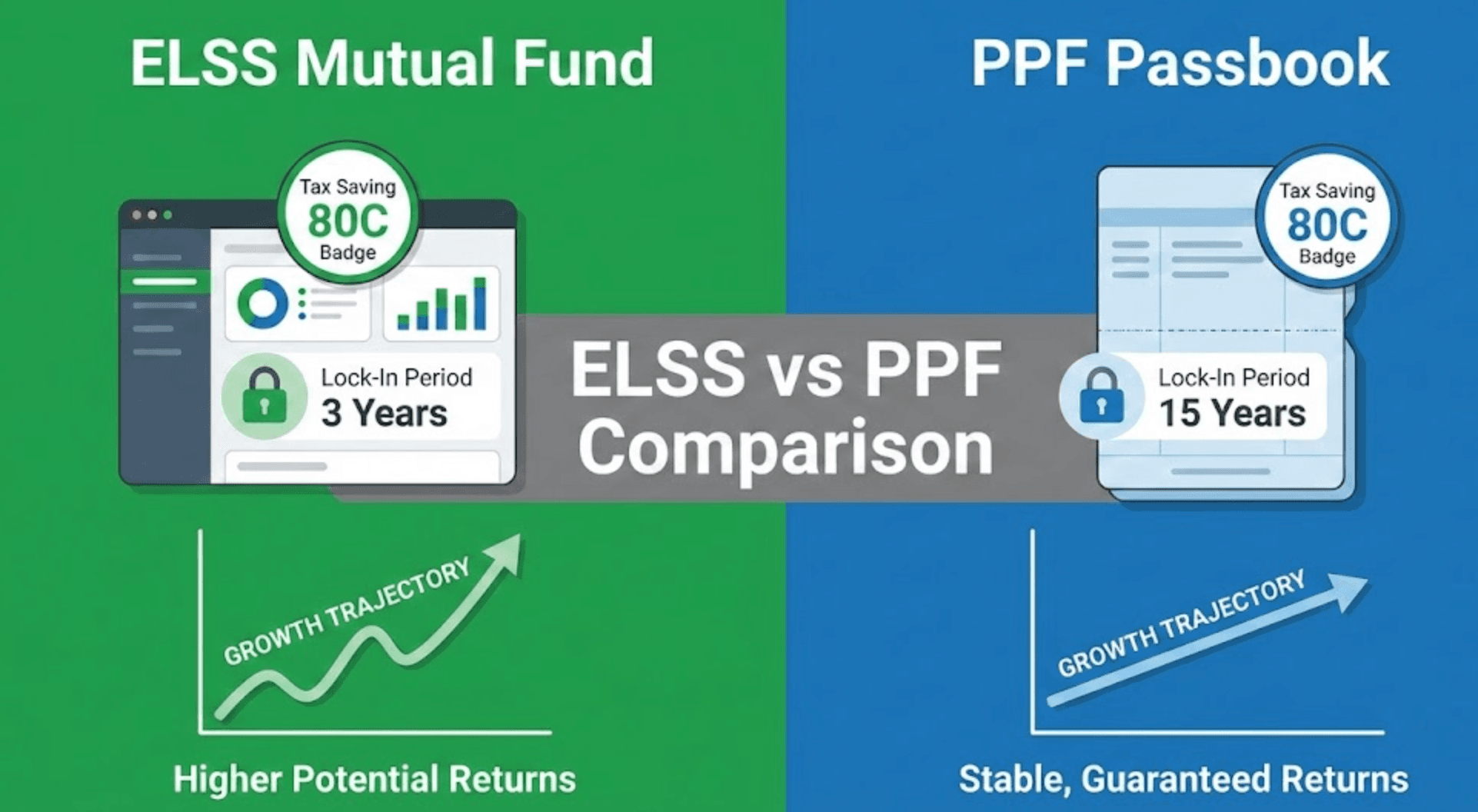
ELSS vs PPF: The Ultimate Tax-Saving Showdown
Both ELSS (Equity Linked Savings Scheme) and PPF (Public Provident Fund) are popular Section 80C investments, but they serve different purposes. This comprehensive guide helps you choose wisely.
Quick Comparison
| Parameter | ELSS | PPF |
|---|---|---|
| Returns | 12-15% (market-linked) | 7.1% (guaranteed) |
| Lock-in Period | 3 years | 15 years |
| Risk Level | High (equity) | Zero (government-backed) |
| Tax on Returns | LTCG 12.5% above ₹1.25L | Fully tax-free (EEE) |
| Min Investment | ₹500 (SIP) | ₹500/year |
| Max Investment | No limit | ₹1.5 lakh/year |
| Liquidity | After 3 years | Partial after 7 years |
| Loan Facility | No | Yes (3rd-6th year) |
Understanding ELSS
What is ELSS? ELSS is a type of equity mutual fund that invests minimum 80% in equities and qualifies for Section 80C deduction.
Key Features:
- •Lock-in: 3 years (shortest among 80C options)
- •Investment Mode: Lump sum or SIP
- •NAV-based: Returns depend on market performance
- •Diversification: Across sectors and market caps
ELSS Returns History (Top Funds):
| Period | Average ELSS Returns |
|---|---|
| 1 Year | 15-25% (varies) |
| 3 Years | 12-18% CAGR |
| 5 Years | 14-18% CAGR |
| 10 Years | 12-15% CAGR |
ELSS Taxation (Post July 2024):
- •STCG (≤3 years): Not applicable (lock-in)
- •LTCG (>3 years): 12.5% above ₹1.25 lakh exemption
Example:
- •Investment: ₹1,50,000
- •Value after 3 years (15% CAGR): ₹2,28,094
- •Gain: ₹78,094
- •Tax: ₹0 (below ₹1.25L exemption)
Understanding PPF
What is PPF? PPF is a government-backed savings scheme with guaranteed returns and complete tax exemption.
Key Features:
- •Lock-in: 15 years (extendable in 5-year blocks)
- •Interest Rate: 7.1% (Q4 FY25), revised quarterly
- •Tax Status: EEE (Exempt-Exempt-Exempt)
- •Government Guarantee: 100% safe
PPF Interest Rate History:
| Year | Interest Rate |
|---|---|
| 2024-25 | 7.1% |
| 2023-24 | 7.1% |
| 2022-23 | 7.1% |
| 2021-22 | 7.1% |
| 2020-21 | 7.1-7.9% |
| 2019-20 | 7.9-8.0% |
PPF Withdrawal Rules:
- •Partial withdrawal: From 7th year, up to 50% of balance
- •Loan: 3rd to 6th year, up to 25% of balance
- •Premature closure: After 5 years (with conditions)
Detailed Comparison
1. Returns Comparison (₹1.5L/year for 15 years)
| Scenario | ELSS @12% | ELSS @15% | PPF @7.1% |
|---|---|---|---|
| Total Investment | ₹22.5L | ₹22.5L | ₹22.5L |
| Maturity Value | ₹56.0L | ₹71.8L | ₹40.7L |
| Total Gain | ₹33.5L | ₹49.3L | ₹18.2L |
| Tax on Gains | ~₹4L | ~₹6L | ₹0 |
| Net Value | ₹52L | ₹65.8L | ₹40.7L |
2. Risk Comparison
| Risk Factor | ELSS | PPF |
|---|---|---|
| Capital Loss | Possible | Impossible |
| Return Variability | High | None |
| Inflation Risk | Lower (equity beats inflation) | Higher (fixed rate) |
| Default Risk | Fund-dependent | Zero (sovereign) |
3. Liquidity Comparison
| Aspect | ELSS | PPF |
|---|---|---|
| Lock-in | 3 years per unit | 15 years total |
| SIP Liquidity | Each SIP has own 3-year lock | Entire account locked |
| Emergency Access | After lock-in | Loan/partial withdrawal |
| Exit Load | Usually none after lock-in | Penalty on premature closure |
4. Tax Efficiency
| Tax Aspect | ELSS | PPF |
|---|---|---|
| Investment | 80C deduction | 80C deduction |
| Growth | Taxable (LTCG) | Tax-free |
| Maturity | Taxable above ₹1.25L | Fully tax-free |
| Effective Tax | ~2-3% of gains | 0% |
When to Choose ELSS
✅ Choose ELSS if:
- •You have 7+ years investment horizon
- •Can tolerate short-term volatility
- •Want higher inflation-beating returns
- •Need liquidity after 3 years
- •Already have debt allocation (EPF, FD)
- •Young with high risk capacity
- •Want to build equity portfolio
Best ELSS Strategy:
- •Start SIP early in financial year
- •Continue beyond lock-in for compounding
- •Don't redeem just because lock-in ends
- •Choose direct plans for lower expense ratio
When to Choose PPF
✅ Choose PPF if:
- •Risk-averse investor
- •Want guaranteed, predictable returns
- •Building retirement corpus
- •Need loan facility
- •In highest tax bracket (30%+)
- •Want completely tax-free returns
- •Already have equity exposure
Best PPF Strategy:
- •Invest before 5th of month (interest calculation)
- •Max out ₹1.5L limit annually
- •Don't withdraw prematurely
- •Extend in 5-year blocks after maturity
The Optimal Strategy: Use Both
Recommended Allocation:
| Investor Profile | ELSS | PPF | Reasoning |
|---|---|---|---|
| Young (25-35) | 70% | 30% | Higher risk capacity |
| Mid-Career (35-45) | 50% | 50% | Balanced approach |
| Pre-Retirement (45-55) | 30% | 70% | Capital preservation |
| Conservative (Any age) | 30% | 70% | Safety first |
| Aggressive (Any age) | 80% | 20% | Growth focus |
Example: ₹1.5L 80C Allocation
| Profile | ELSS | PPF | Other 80C |
|---|---|---|---|
| Young Professional | ₹1L | ₹50K | - |
| Family Person | ₹75K | ₹75K | - |
| Conservative | ₹50K | ₹1L | - |
| With EPF | ₹1L | - | EPF ₹50K |
ELSS vs PPF vs Other 80C Options
| Option | Returns | Lock-in | Risk | Liquidity |
|---|---|---|---|---|
| ELSS | 12-15% | 3 years | High | Good |
| PPF | 7.1% | 15 years | Zero | Low |
| NPS | 8-10% | Till 60 | Medium | Very Low |
| NSC | 7.7% | 5 years | Zero | Low |
| Tax Saver FD | 6-7% | 5 years | Zero | Low |
| ULIP | 8-12% | 5 years | Medium | Medium |
| Sukanya | 8.2% | 21 years | Zero | Very Low |
Common Mistakes to Avoid
- •
Choosing based on last year's returns
- •ELSS returns vary; look at 5-10 year track record
- •
Ignoring asset allocation
- •Don't put all 80C in one instrument
- •
Redeeming ELSS at lock-in end
- •Continue for long-term wealth creation
- •
Not maxing out PPF
- •₹1.5L limit is use-it-or-lose-it
- •
Timing the market with ELSS
- •SIP throughout year beats lump sum timing
Tax Saving Calculation
For 30% Tax Bracket:
| Investment | Amount | Tax Saved |
|---|---|---|
| ELSS | ₹1,50,000 | ₹46,800 |
| PPF | ₹1,50,000 | ₹46,800 |
| Split 50-50 | ₹1,50,000 | ₹46,800 |
Tax saved is same; difference is in returns and risk.
Use KnowYourFinance's SIP Calculator and PPF Calculator to plan your tax-saving investments!
Sources & References
Disclosure & Update History
This content is for educational purposes only and is not personalized financial, tax, or legal advice.
Update history
- Originally published on 18 December 2025.
- Latest editorial review completed on 18 December 2025.
- Sources cited on this page are reviewed during each editorial refresh.
Tags
Written by Amodh Shetty
Amodh is a personal finance educator and the founder of KnowYourFinance. He focuses on Indian taxation, investing, insurance, and household decision-making frameworks.
Editorial disclosure: The author holds investments in broad-market index funds and SGBs. This article is strictly for educational purposes and does not constitute professional investment advice.
Need Calculators Alongside the Guide?
The article stands on its own. If you want an iPhone companion for running scenarios, saving inputs, and using India-focused calculators, you can use the KnowYourFinance app.
Explore the iPhone App