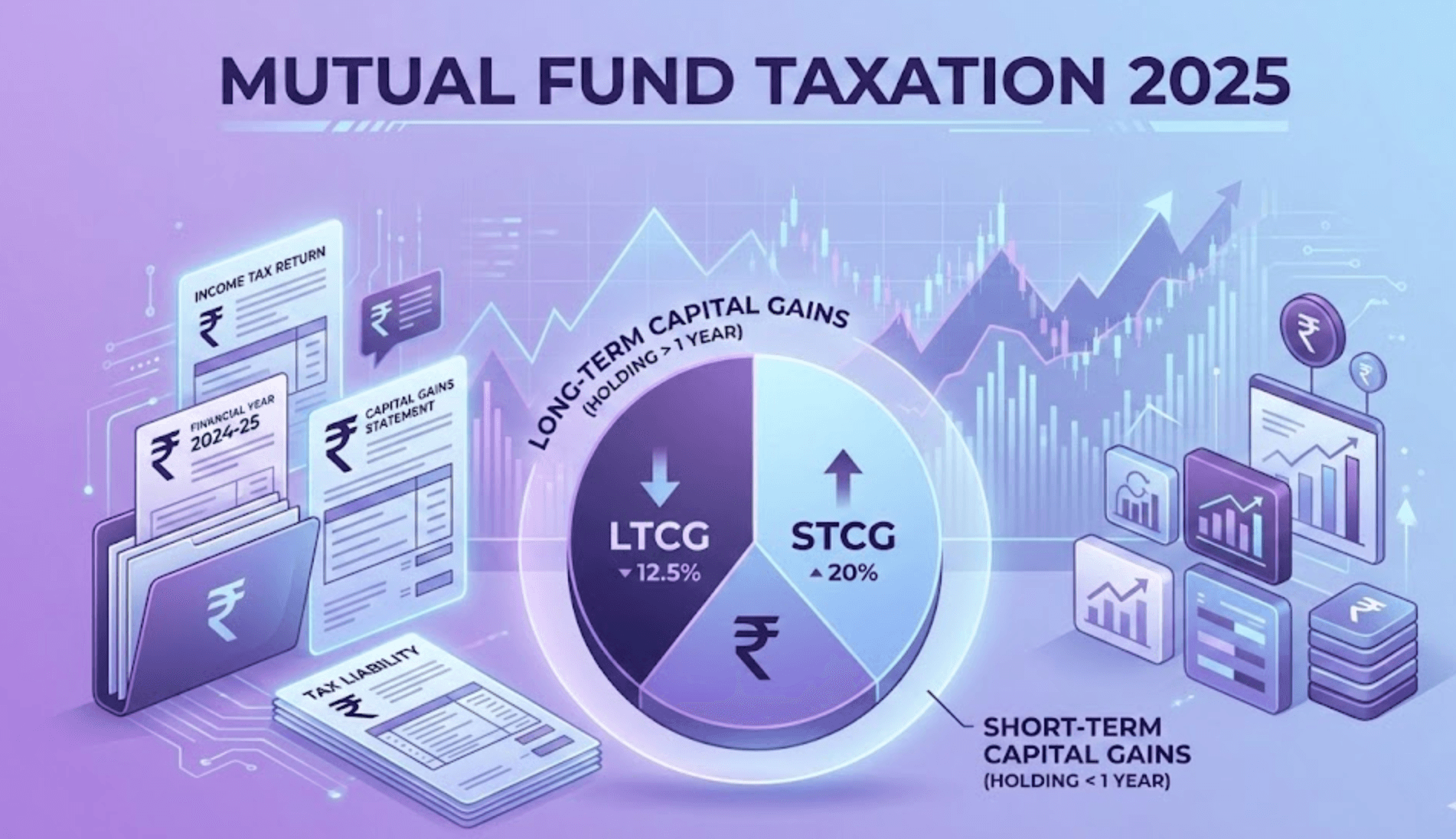
Mutual Fund Taxation India 2025: Complete Guide
The Union Budget 2024 (announced July 23, 2024) brought significant changes to mutual fund taxation. This comprehensive guide covers all the new rules effective for FY 2025-26.
Key Changes from July 2024 Budget
| Aspect | Before July 2024 | After July 2024 |
|---|---|---|
| Equity STCG | 15% | 20% |
| Equity LTCG | 10% above ₹1L | 12.5% above ₹1.25L |
| Debt Fund LTCG | 20% with indexation | Slab rate (no indexation) |
| Hybrid LTCG period | 36 months | 24 months |
1. Equity-Oriented Mutual Funds (≥65% in Indian Equities)
Includes: Large-cap, mid-cap, small-cap, ELSS, index funds, aggressive hybrid funds, arbitrage funds
Tax Rules (From July 23, 2024):
| Holding Period | Tax Type | Tax Rate | Exemption |
|---|---|---|---|
| ≤12 months | STCG | 20% | None |
| >12 months | LTCG | 12.5% | ₹1.25 lakh/year |
Example - Equity Fund:
- •Investment: ₹10,00,000 in Jan 2024
- •Sold in Feb 2026 (25 months): Value ₹15,00,000
- •Gain: ₹5,00,000 (LTCG)
- •Exemption: ₹1,25,000
- •Taxable: ₹3,75,000
- •Tax: ₹3,75,000 × 12.5% = ₹46,875 (+ cess)
2. Debt-Oriented Mutual Funds (≤35% Equity)
Includes: Liquid funds, overnight funds, money market, gilt funds, corporate bond funds, banking & PSU funds
Critical Rule Change:
| Purchase Date | Tax Treatment |
|---|---|
| Before April 1, 2023 | LTCG @12.5% after 24 months (no indexation) |
| On/After April 1, 2023 | Always taxed at slab rate (no LTCG benefit) |
Example - Debt Fund (Bought May 2023):
- •Investment: ₹20,00,000
- •Sold after 3 years: Value ₹26,00,000
- •Gain: ₹6,00,000
- •Tax (30% slab): ₹1,80,000 (+ cess)
Impact: Debt funds are now less tax-efficient for high-income investors compared to equity or direct bonds.
3. Hybrid Mutual Funds (35-65% Equity)
Includes: Balanced hybrid, multi-asset allocation, conservative hybrid funds
Tax Rules:
| Holding Period | Tax Type | Tax Rate |
|---|---|---|
| ≤24 months | STCG | Slab rate |
| >24 months | LTCG | 12.5% (no indexation) |
4. International Funds, Gold Funds & Fund of Funds
Tax Treatment (Post April 2023):
- •All gains taxed at slab rate
- •No LTCG benefit regardless of holding period
- •Same as debt funds
Dividend Taxation
Important: Dividends are NOT tax-free anymore (since April 2020)
| Aspect | Tax Treatment |
|---|---|
| Tax Rate | Added to income, taxed at slab rate |
| TDS | 10% if dividend >₹5,000/year from one AMC |
| NAV Impact | NAV reduces by dividend amount |
Recommendation: Prefer Growth option over Dividend option for tax efficiency.
Tax-Loss Harvesting & Set-Off Rules
Setting Off Losses:
| Loss Type | Can Set Off Against |
|---|---|
| STCL (Equity) | STCG + LTCG (any asset) |
| LTCL (Equity) | LTCG only (any asset) |
| STCL (Debt) | STCG + LTCG (any asset) |
Carry Forward: Unabsorbed losses can be carried forward for 8 years
Example:
- •Equity Fund A: LTCG ₹2,00,000
- •Equity Fund B: LTCL ₹80,000
- •Net taxable LTCG: ₹1,20,000
- •After ₹1.25L exemption: ₹0 tax
Quick Reference: MF Taxation Summary
| Fund Type | STCG Period | STCG Rate | LTCG Period | LTCG Rate |
|---|---|---|---|---|
| Equity (≥65%) | ≤12 months | 20% | >12 months | 12.5%* |
| Debt (≤35%) | Any | Slab | Any | Slab |
| Hybrid (35-65%) | ≤24 months | Slab | >24 months | 12.5% |
| International | Any | Slab | Any | Slab |
| Gold/FoF | Any | Slab | Any | Slab |
*₹1.25 lakh annual exemption across all equity investments
Tax-Saving Strategies
1. LTCG Harvesting
- •Book profits up to ₹1.25 lakh annually (tax-free)
- •Reinvest immediately to reset cost basis
- •Save ₹15,625 in tax every year
2. Hold Equity Funds >12 Months
- •STCG: 20% vs LTCG: 12.5%
- •Difference of 7.5% on gains
3. Use SWP for Regular Income
- •Systematic Withdrawal Plan
- •Only gains portion taxed, not principal
- •More tax-efficient than dividends
4. ELSS for Section 80C
- •₹1.5 lakh deduction under 80C
- •3-year lock-in (shortest among 80C options)
- •Equity taxation applies
5. Avoid Debt Funds for High Tax Brackets
- •Consider direct bonds, SGBs, or arbitrage funds
- •Arbitrage funds get equity taxation (65%+ in arbitrage)
NRI Taxation on Mutual Funds
| Fund Type | STCG TDS | LTCG TDS |
|---|---|---|
| Equity | 20% + surcharge | 12.5% + surcharge |
| Debt | 30% + surcharge | 30% + surcharge |
NRIs can claim refund if actual tax liability is lower.
Reporting in ITR
Schedule CG (Capital Gains):
- •Report all redemptions
- •Separate sections for STCG and LTCG
- •Equity gains under Section 111A (STCG) and 112A (LTCG)
Documents Needed:
- •Capital Gains Statement from AMC
- •Consolidated Account Statement (CAS)
- •Transaction history
Frequently Asked Questions
Q: Is SIP taxed differently? A: Each SIP installment is treated as a separate purchase. FIFO (First In First Out) method applies for redemption.
Q: Are switch transactions taxable? A: Yes, switching between funds is a redemption + purchase, triggering capital gains tax.
Q: What about bonus units? A: Bonus units have zero cost. Full sale value is capital gain.
Q: How to calculate gains for SIP? A: Use FIFO method - oldest units sold first. Each unit has its own purchase date and cost.
Use KnowYourFinance app to track your mutual fund investments and calculate tax liability accurately!
Sources & References
Disclosure & Update History
This content is for educational purposes only and is not personalized financial, tax, or legal advice.
Update history
- Originally published on 8 December 2025.
- Latest editorial review completed on 8 December 2025.
- Sources cited on this page are reviewed during each editorial refresh.
Tags
Written by Amodh Shetty
Amodh is a personal finance educator and the founder of KnowYourFinance. He focuses on Indian taxation, investing, insurance, and household decision-making frameworks.
Editorial disclosure: The author holds investments in broad-market index funds and SGBs. This article is strictly for educational purposes and does not constitute professional investment advice.
Need Calculators Alongside the Guide?
The article stands on its own. If you want an iPhone companion for running scenarios, saving inputs, and using India-focused calculators, you can use the KnowYourFinance app.
Explore the iPhone App