The Midnight Panic
It is a Tuesday night.
You just started your career 8 months ago. Your salary is decent, but you have been moving cities, setting up an apartment, and maybe indulging in a bit of "lifestyle inflation." Your savings account balance is roughly ₹4,000.
Your emergency fund? Non-existent.
Then, life happens. Maybe it is a severe medical emergency not fully covered by your corporate insurance. Maybe your laptop, the absolute tool of your livelihood, dies irretrievably. Or maybe a family member back home needs an urgent financial injection.
You need ₹1 Lakh. Right now. By tomorrow morning.
The panic sets in. You have zero savings. The money has to come from somewhere, which means you have to borrow it. In 2026, getting a loan in India is terrifyingly easy. Your phone is filled with apps offering you "Instant Cash." Your credit card limit is winking at you.
But this exact moment is the crossroads that separates financially stable adults from those trapped in a decade of crushing debt.
Picking the wrong loan right now will not just cost you money; it will cost you your peace of mind, your credit score, and years of compound interest.
This is the beginner's survival guide to choosing a loan when you have zero backup.
The Dark Forest: Understanding the "Credit Card Trap"
When an emergency hits, the physical piece of plastic in your wallet feels like a magic wand. You have a massive credit limit. Why not just swipe it?
Because swiping a credit card for a massive emergency is financial suicide if you do not understand the math.
The Mechanism of the Trap
A credit card is a 30-to-45 day interest-free loan. If you swipe ₹1 Lakh today, and the bill arrives next month, and you pay the FULL ₹1 Lakh, you pay zero interest. It is a fantastic tool.
But you don't have savings. Therefore, next month, you cannot pay the full ₹1 Lakh.
When the bill arrives, the bank gives you an incredibly tempting option: "Pay Minimum Due: ₹5,000." You breathe a sigh of relief. You pay the ₹5,000. You think you are safe.
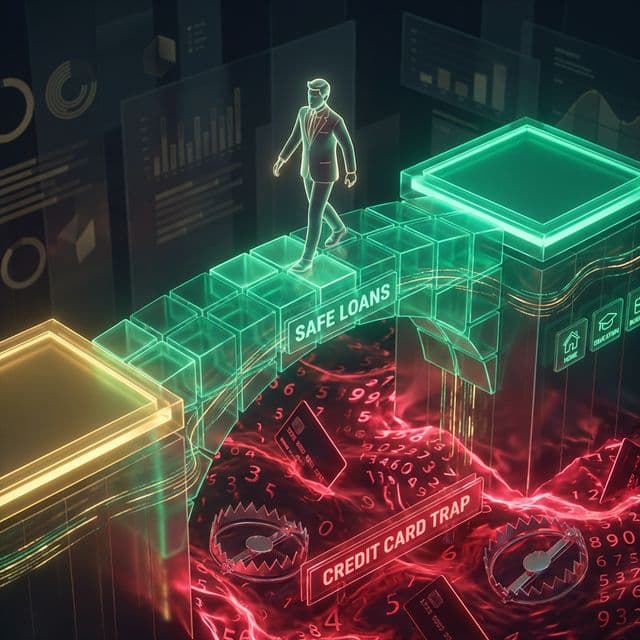
You have just stepped into a bear trap.
The moment you roll over the balance (by paying only the minimum), the bank revokes the "interest-free" period. They now charge you interest on the remaining ₹95,000. But they don't charge you a normal interest rate. They charge you a punitive, chaotic rate, usually between 3% to 3.5% PER MONTH.
That translates to 36% to 42% PER YEAR.
The interest compounds daily. And worse, any new purchases you make on the card from that day forward immediately start accumulating 36% interest from day one.
The Math of Ruin: If you owe ₹1 Lakh on a credit card at 36% APR, and you only ever pay the minimum due (usually 5% of the balance), it will take you over 15 YEARS to clear the debt, and you will end up paying more than ₹1.8 Lakhs purely in interest to the bank.
The Verdict on Credit Cards for Emergencies: Never, ever swipe a credit card for an emergency UNLESS you plan to immediately call the bank customer care and convert that huge transaction into an EMI (Equated Monthly Installment). Converting to an EMI locks in a lower interest rate (usually 14-16%) and forces you to pay down the principal predictably.
Scenario 1: The Small Crisis (₹10,000 to ₹50,000)
Your car broke down, or you need immediate dental surgery. It's a painful hit, but not life-destroying.
The Best Tool: Salary Advance
Many top-tier employers today offer a "Salary Advance" policy. Alternatively, regulated fintech apps (like Refyne or EarlySalary/Fibe) partner with companies to offer earned-wage access.
- •How it works: You pull a portion of your upcoming month's salary today. When payday arrives, the HR department or the app automatically deducts that amount from your paycheck before it hits your bank account.
- •The Cost: It is exceptionally cheap. Usually, there is ZERO interest, just a flat, nominal processing fee (e.g., ₹200 to ₹500 per transaction).
- •The Trap to Avoid: While cheap, a salary advance means your next month's salary will be significantly smaller. If you take a ₹30,000 advance on a ₹60,000 salary, next month you only get ₹30,000 to survive on.
- •The Verdict: Excellent for true micro-emergencies, provided you instantly aggressively cut your discretionary spending next month to survive the smaller paycheck.
The Second Option: Small-Ticket EMI (BNPL)
If it's an emergency purchase (like a replacement laptop or an appliance at a hospital pharmacy that accepts it), Buy Now Pay Later networks like Bajaj Finserv EMI Network or Amazon Pay Later can be useful.
- •How it works: They split the ₹40,000 bill into 4 or 6 equal monthly payments.
- •The Trap: BNPL companies are ruthless with late payments. If you miss an EMI date by a single day, they slap massive penal charges and immediately report the default to CIBIL, tanking your credit score.
- •The Verdict: Acceptable only if you have absolute, iron-clad discipline and certainty that your cash flow can support the monthly EMIs.
Scenario 2: The Major Crisis (₹1 Lakh to ₹5 Lakhs)
This is the big one. A severe medical hospitalization without insurance. Paying a massive legal deposit. Bailing family out of a crisis.
A salary advance won't cover this. A credit card will trap you in a 36% compound interest nightmare.
The Only Viable Tool: The Unsecured Personal Loan
A personal loan is a lump sum of cash given to you by a bank, which you repay over a fixed timeline (usually 1 to 5 years).
- •The Cost: Depending on your credit score and salary, interest rates range from 10.5% to 16% per annum.
- •The Structure: Every month, you pay a fixed EMI. A portion of that EMI goes to paying the interest, and a portion goes to paying down the principal debt.
Why Personal Loans are the Safe Harbor:
- •Fixed Mathematics: Unlike a credit card where the debt floats and compounds chaotically, a personal loan has a strictly defined finish line. You know exactly when it ends.
- •Forced Discipline: You cannot simply "swipe" it again. You get the money once, you deal with the emergency, and you spend the next two years paying it back.
- •Lower Interest: 12% on a personal loan is mathematically survivable. 40% on a credit card is not.
How to Execute It Safely:
- •Go to YOUR bank first: The bank where your salary drops every month has all your data. They often offer "Pre-approved" personal loans that disburse to your account in literally 3 seconds via net banking.
- •Keep the Tenure Short: Choose a repayment timeline of 24 to 36 months, even if it feels slightly tight. Dragging a loan out to 60 months just to lower the EMI means you pay massive amounts of total interest over the lifetime of the loan.
- •Avoid Loan Aggregators Initially: Don't just apply blindly on websites that blast your PAN card out to 20 different NBFCs. Every time a bank checks your CIBIL score for a loan, it registers as a "Hard Inquiry," which drops your score slightly.
The Apex Predators: Unregulated Loan Apps
There is a dark underbelly to the Indian fintech revolution.
If you search the Google Play Store for "Instant Loan App," you will find hundreds of apps with weird names (like "CashRupee," "SpeedLoan," "EasyMoney"). Many of these are completely unregulated, highly illegal predatory loan sharks operating out of shadow servers.
How they destroy beginners:
- •They offer a quick ₹10,000 loan to a desperate beginner.
- •They demand wide-ranging permissions on your phone (access to Contacts, Photo Gallery).
- •They disburse the money, but deduct a massive "processing fee" upfront (you ask for ₹10k, you get ₹7,000).
- •They demand repayment in 7 or 15 days at an annualized interest rate exceeding 150%.
- •The Extortion: If you don't pay on day 7, they access your phone's contact list and send abusive, morphed WhatsApp messages to your parents, boss, and colleagues claiming you are a thief.
The Golden Rule: Never, ever install a loan app that is not explicitly and clearly backed by an RBI-registered NBFC (Non-Banking Financial Company) or a major Bank. If the "About Us" section of the app doesn't list a legitimate corporate entity, close it. No emergency is worth digital extortion.
The Ultimate Hierarchy of Action
If you are a beginner sitting in a hospital waiting room with no savings, here is the exact order of operations to fund the crisis:
- •Liquidate First: Sell those obscure mutual funds. Break the ₹20,000 FD your grandmother made for you. Using your own money is always better than borrowing.
- •0% Salary Advance / Employer Loan: Talk to your HR. Many companies offer absolute zero-interest medical advances for employees in emergencies.
- •The Family Network (Swallow Your Pride): Borrowing ₹2 Lakhs from an uncle at 0% interest with a strict repayment written agreement is better than owing a bank. Do not let pride push you into a high-interest trap.
- •Pre-Approved Bank Personal Loan (Via HDFC, SBI, ICICI, etc.): Take exactly what you need, set up an aggressive 24-month EMI.
- •Credit Card EMI Conversion: Swipe the card for the hospital bill, immediately call the bank, and convert the massive transaction into a 12-month EMI.
The Post-Crisis Mandate
Once the storm passes, the dust settles, and you begin paying your EMIs, you must acknowledge a harsh truth: This crisis was far more painful than it needed to be because you had no buffer.
Your primary, overwhelming financial goal for the next 12 months is not investing in crypto. It is not buying stocks.
It is building a 6-Month Emergency Fund in a boring, highly liquid Fixed Deposit or Liquid Mutual Fund. The day you have ₹3 Lakhs sitting there quietly, untouchable, the panic will never hit you like this again.
You will have bought the most valuable asset in personal finance: The ability to sleep peacefully when a crisis hits.
Frequently Asked Questions
Is it better to take a Personal Loan or swipe my Credit Card for a ₹2 Lakh hospital bill?+
What are those random loan apps on the App Store promising money in 5 minutes?+
How do I avoid getting into this situation again?+
Sources & References
Disclosure & Update History
This content is for educational purposes only and is not personalized financial, tax, or legal advice.
Update history
- Originally published on 26 February 2026.
- Latest editorial review completed on 25 February 2026.
- Sources cited on this page are reviewed during each editorial refresh.
Tags
Written by Amodh Shetty
Amodh is a personal finance educator and the founder of KnowYourFinance. He focuses on Indian taxation, investing, insurance, and household decision-making frameworks.
Editorial disclosure: The author holds investments in broad-market index funds and SGBs. This article is strictly for educational purposes and does not constitute professional investment advice.
Need Calculators Alongside the Guide?
The article stands on its own. If you want an iPhone companion for running scenarios, saving inputs, and using India-focused calculators, you can use the KnowYourFinance app.
Explore the iPhone App